

By David Okoh

*doctoral research ranked among most outstanding
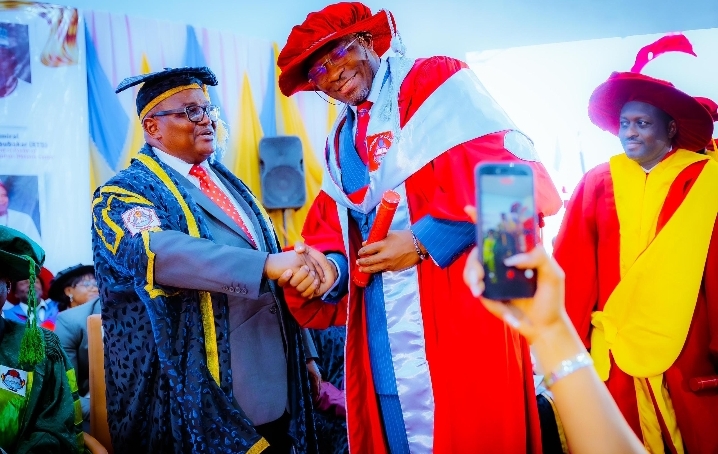
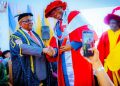
ABUJA—The Deputy Speaker of the House of Representatives, Rt. Hon. Benjamin Okezie Kalu, has added another feather to his cap, receiving a Doctor of Laws (PhD) degree from the University of Calabar during its 38th Convocation Ceremony. The conferment marks not merely a personal academic triumph but a significant moment in Nigeria’s ongoing struggle to position knowledge at the center of national development.
In a ceremony that underscored the rigorous demands of doctoral scholarship, Kalu’s research was selected for the University’s prestigious Achievement Exhibition on Contribution to Knowledge—a recognition reserved for work demonstrating exceptional originality and practical relevance to societal challenges.
From Agbamuzu to Academic Eminence
Kalu’s journey to this milestone reflects a deep, sustained relationship with the University of Calabar that spans decades. Having previously earned his LL.B and LL.M degrees from the same institution, the Deputy Speaker described the moment as deeply personal, acknowledging how the university shaped his intellectual foundation across multiple academic stages.
“This is homecoming in its truest sense,” Kalu remarked during his Vote of Thanks address, delivered on behalf of the graduating class. “The roots of education are bitter, but the fruit is sweet,” he continued, invoking Aristotle’s timeless observation on the nature of learning.
The Deputy Speaker did not shy away from the less glamorous realities of advanced scholarship. He spoke candidly about the “sleepless nights, intellectual struggles, and moments of doubt” that characterize the doctoral journey, framing the achievement not as a destination but as a testament to “resilience and dedication.”
The Weight of the Credential
Perhaps the most striking note in Kalu’s address was his deliberate reframing of what a PhD represents within the Nigerian context. Citing National Bureau of Statistics data showing fewer than 100,000 doctoral degree holders in a nation of over 220 million people, Kalu positioned the credential not as a marker of privilege but as a profound responsibility.
“We belong to a very narrow community,” he observed. “This is not about exclusivity—it is about the burden of thought and the call to intellectual leadership that rests upon us.”
The statistics reveal the stark reality of Nigeria’s knowledge gap. With doctoral holders representing less than 0.05 percent of the population, the country faces what education experts describe as a critical shortage of high-level human capital necessary for driving innovation and policy sophistication.
Legislative Footprints in Education
Kalu’s academic pursuit aligns with tangible legislative commitments to expanding educational access. As Deputy Speaker, he has championed the establishment of three federal institutions: the Federal College of Education in Bende, the Federal University of Medical and Health Sciences in Item Bende, and the Federal University in Okigwe.
“These are not merely political achievements to be tallied during election cycles,” Kalu emphasized. “They represent long-term investments in Nigeria’s intellectual future—infrastructure that will outlast our individual political careers.”
A Call to Transformation
Invoking Nelson Mandela’s declaration that “education is the most powerful weapon which you can use to change the world,” Kalu urged his fellow doctoral graduates to embrace roles as “agents of transformation” rather than passive beneficiaries of academic status.
His message carried particular urgency given Nigeria’s documented challenges with graduate employability. Recent NBS data indicates that approximately 16.9 percent of doctoral holders in the country face unemployment or underemployment—a paradox that underscores the disconnect between academic qualification and economic opportunity.
“The gap between knowledge generation and societal application must be bridged,” Kalu insisted. “Our research must translate into real-world impact, our expertise into policy innovation, and our credentials into service delivery.”
Institutional Recognition
The University of Calabar’s decision to elevate Kalu’s research to its Achievement Exhibition reflects institutional confidence in the practical applicability of his scholarly work. The Governing Council and Senate specifically recognized the research’s contribution to advancing knowledge in ways that extend beyond theoretical abstraction.
As Chairman of the House Committee on Constitution Review, Kalu’s enhanced academic credentials carry implications for ongoing legislative efforts to amend Nigeria’s foundational legal document. The convergence of practical legislative experience with advanced academic training positions him uniquely to navigate the complex technical and political challenges inherent in constitutional reform.
Looking Forward
Kalu’s conferment arrives at a pivotal moment in Nigeria’s educational trajectory. With the country striving toward the African Union’s target of dedicating at least one percent of GDP to research and development, the presence of credentialed leaders who have navigated the rigorous demands of doctoral research assumes heightened significance.
The Deputy Speaker’s parting message to his cohort reflected both celebration and solemn obligation: “We have earned the right to be heard in academic discourse. The question before us now is whether we will use that voice to amplify ideas that transform our nation or merely to defend privileges we have accumulated.”
As the 38th Convocation recedes into memory, the measure of Kalu’s doctoral achievement will likely be determined not by the weight of his dissertation or the ceremony’s pomp, but by whether the intellectual rigor demonstrated in earning the degree translates into the “real-world impact” he so emphatically championed.
For a nation seeking to convert its demographic weight into human capital advantage, the example of leaders who prioritize continuous learning while building institutional frameworks for knowledge generation offers a template worthy of emulation.